« Author Archive
posted by
Shawn, on October 10th, 2007 at 05:53 pm, in category
Uncategorized
Contrary to popular belief, Scott Boras has not gone off the deep end. In fact, I would say he understands the baseball business far better than most analysts, and infinitely better than any other agent. Boras was on ESPN Radio earlier in the week, and here’s the excerpt that’s getting most of the attention:
One of the other things that Alex has that… few players have, is he has network value. That means for a regional sports network he has an impact on in that may allow that regional sports network to increase by a half-a-billion to a billion dollars over a 10-year period because of the ratings increase that he will bring. His fan base will subscribe to that network to watch him play and they will sell more advertising. This has certainly been evidenced in New York.
Yes, this is a negotiating tactic. And yes, he’s probably overstating A-Rod’s value to a team’s RSN by a bit. […]
posted by
Shawn, on October 3rd, 2007 at 01:29 am, in category
Uncategorized
In Baseball Between the Numbers, Nate Silver’s fantastic chapter, “Is Alex Rodriguez Overpaid?” highlighted a seminal fact about the player market: despite what your sports econ professor may have told you, the relationship between a team’s win total and its marginal revenue is not linear. Instead, there is actually a “sweet spot,” as he called it, at around 90 wins, where each additional victory is worth a great deal more than at any other range.
The reason is pretty simple: a team makes millions of extra dollars every time it hosts a postseason game. Nate estimated that, on average, a playoff appearance is worth just under $6 million, with plenty of room for upward mobility. A team that wins 100 games will almost surely make the playoffs, and a team that wins 60 surely will not. Adding a five-win player to either of these teams doesn’t do much to change their short term revenue potential. […]
posted by
Shawn, on October 1st, 2007 at 09:00 am, in category
Player Salaries,
RAS
Let’s pick on Tom Hicks for a bit.
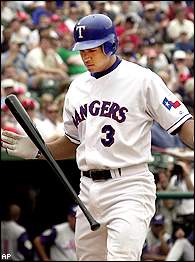 Last week we discussed the bubble that took hold in the player market in the late ‘90s and early ‘00s, and also determined that the current market still has room to grow. While there has been some tremendous work done on predicting player performance, little attention has been spent on forecasting the market. Why is this important? When dealing with long-term contracts, there are two questions a team must answer: how will this player perform, and how much will that level of play cost on the market through the life of the deal?
By 2000, MLB revenues had grown almost 140 percent over the previous decade. When the Rangers handed the keys to their castle to Alex Rodriguez, they likely expected revenues, and in turn player salaries, to keep skyrocketing at a similar rate. […]
posted by
Shawn, on September 27th, 2007 at 10:38 pm, in category
Market Inefficiencies,
Player Valuation
We’re done talking about Walt Jocketty, but being that this is the second part of a series, we figured we would keep the name.
In the first part, we determined that the market for pitching is irrationally expensive, and contemplated some solutions to get around it. But up to this point we have mostly been discussing starters, when they are only responsible for about two thirds of all innings pitched. Filling these other innings with solid, dependable, cost efficient arms can go a long way toward offsetting the potentially bloated costs of a team’s rotation. For a number of reasons reasons, talented minor league (or even major league) relievers often slip through the cracks, toiling away in obscurity when they could be helping a big league team win games.
While several teams have been particularly adept at finding free talent relievers to stock their bullpens, the leaders in the clubhouse are the San Diego Padres. Year after year, GM Kevin Towers continues to find diamonds in the rough. Scott Linebrink. Doug Brocail. Rudy Seanez. Akinori Otsuka. Alan Embree. Scott Cassidy. Cla Meredith. Heath Bell. All of these men have found success in the Padres pen over the last four years while pulling in salaries at or near the league minimum. […]
posted by
Shawn, on September 26th, 2007 at 01:18 am, in category
Market Inefficiencies,
Player Valuation
Consider the plight of a modern day general manager. His team needs pitching, but a somewhat consistent league-average starter will cost him at least $30 million in present value, and possibly upwards of $50 million. He knows this is too much to spend, but the idea starting the season with Mark Redman in his rotation is keeping him up at night. What to do?
Say a married couple of reasonable means is looking to buy a house, but the market is irrationally high at the moment (as we have already discovered the market for pitching currently is). They have three main options: 1) buy an overpriced house; 2) continue to rent, hoping that the market comes back down soon enough; 3) acknowledge that the market is inefficient, and look for alternative ways to beat it.
Viewing starting pitchers in the same manner, teams have generally acted in one of these three ways with different levels of success. Jeff Suppan, Barry Zito, and Gil Meche (among others) were, essentially, the irrationally expensive houses on the market. Greg Maddux, signed to a one-year deal by the Padres, would be the equivalent of renting, in the sense that he fills a pressing need but is not a long-term asset. […]
posted by
Shawn, on September 24th, 2007 at 02:54 pm, in category
Player Salaries,
Revenues,
RAS
With baseball’s revenues growing at a blistering rate, it has become more and more difficult for analysts to accurately dissect big-money, multi-year signings. What we thought we knew just two years ago seems to be obsolete, with the market shifting upwards at breakneck speed.
Yes, we’ve seen this before. Culminating with the infamous winter of ’01, Major League payrolls rose between thirteen to nineteen percent annually for five consecutive years. Overall, teams spent almost four and a half times as much on player salaries in 2001 as they did in 1990.
With Armageddon warnings seemingly plastered on every team’s office walls, sensibility (or perhaps collusion) eventually resurfaced. Payrolls rose only moderately in 2002 and 2003, and actually declined a bit in 2004. The bubble had burst, leaving teams that had signed players to mega-deals in previous years shaking their heads, and/or calling Brian Cashman for a little relief. […]
posted by
Shawn, on September 24th, 2007 at 01:30 am, in category
Market Inefficiencies,
Free Agency,
Player Valuation
“The market right now is kind of silly, and it may continue to be silly.”
- St. Louis Cardinals general manager Walt Jocketty (ESPN.com; November 28, 2006)
So just how silly is the market?
Quite, actually, but particularly when it comes to pitchers.
But doesn’t defense win championships? Isn’t that the idea that we’ve all been taught, weaned on, suffocated with, what have you? Shouldn’t there be a premium on pitching, if it is really that important?
Let’s consider. Wins can be broken down and credited to three major factors: runs scored, runs allowed, and luck. Pitchers have almost no effect on how many runs their team scores, but a substantial hand in how many their team allows. Substantial is the key word here. Most fans and, incredibly, team execs seem to believe that a pitcher is almost entirely responsible for the runs he lets up, hence the reliance on ERA to evaluate performance. […]